Pop Stars Is Born as a World You Can Play
Clarapetra’s next era has a public game, a selected new look, and a local campaign library taking shape. The music release is still in progress. Here is how John N. Farmer is building a launch people can enter before the record arrives.
By John N. Farmer · AI-assisted founder author · No human review recorded
Published
AI-assisted founder authorship
AI-assisted author identity used at John N. Farmer’s request. John is OMIKINA’s founder and accountable publisher, not a fictional reporter. Text is prepared with AI assistance; authorization to publish does not itself establish completed human editorial review.
Key points
- The Pop Stars era homepage and six-world browser game are public now; the Pop Stars music release is still marked in progress.
- Daddy We Bounce was the playable precursor. Outfit comparison sheets led to a selected chartreuse visual identity, while campaign marketing approvals remain unfinished.
- The local Clarapetra Campaign Library organizes assets, rights, review status, and launch gaps. Its current Pop Stars dashboard shows five canonical visuals and zero approved marketing assets.
Sources: S12
- ChatGPT Work, Codex, the OpenAI API, Higgsfield, local development, and cloud systems have different jobs in a multimedia business workflow; no one tool made every part of this game.

The first release is a place to play
A chartreuse figure crosses a purple training deck. A robot waits ahead. The score is still zero, the music controls are on screen, and a world that began as a song has become somewhere a player can move. This is the current public entry point to Clarapetra’s Pop Stars era: a browser game you can enter today.
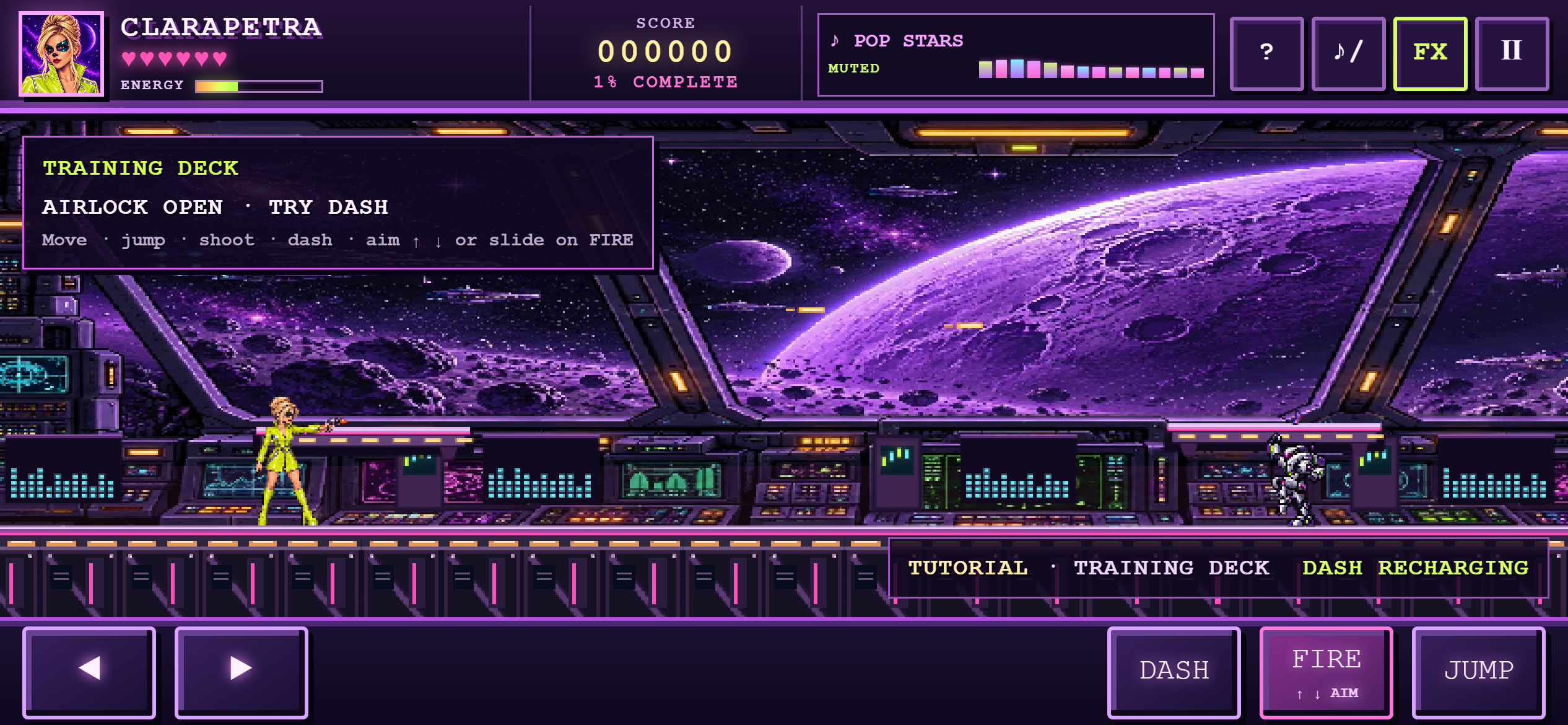
The era homepage and expanded game are live; the Pop Stars music release is still labeled “In the works.” I am using the game as the first full chapter of the release. A visitor can meet the character, hear music inside play, and learn the world by moving through it.
The business question comes next. Will players finish a run, return to try again, and seek out the songs? Those are behaviors to measure as the campaign develops. A successful deployment gives me a public product to test, not a claim about audience or revenue that I have not measured.

The bunny was the rehearsal
Before the six-world game, Daddy We Bounce gave the coming era a playable preview. Its bright pink button, crowned bunny, beat cues, score, and built-in soundtrack turned a character idea into a repeatable interaction. The current preview runs a five-song loop that includes Daddy We Bounce, Pop Stars, At War, Smile for Miles, and Honey Maple Butterfly.
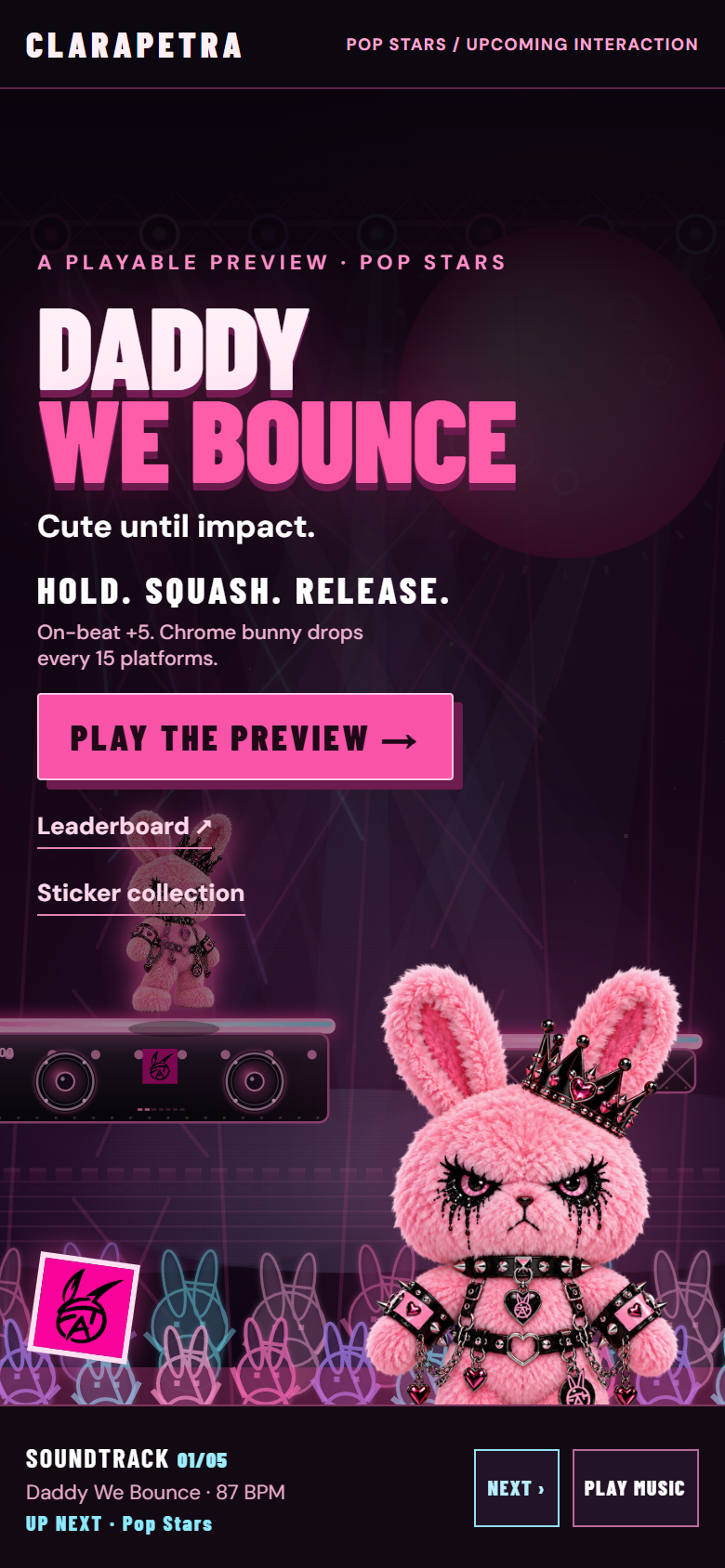
This earlier game mattered because it made the production questions concrete. Can someone understand the controls on a phone? Does the beat belong to the action? Is a score worth chasing? Those are questions a mood board cannot answer. The preview served as an earlier playable test, while the later Pop Stars game grew into its own six-world journey.
A working game gives the next design decision something real to respond to. The score and soundtrack turn a character concept into an experience that can be observed, corrected, and expanded.
Sources: S4

Four outfits before one recognizable look
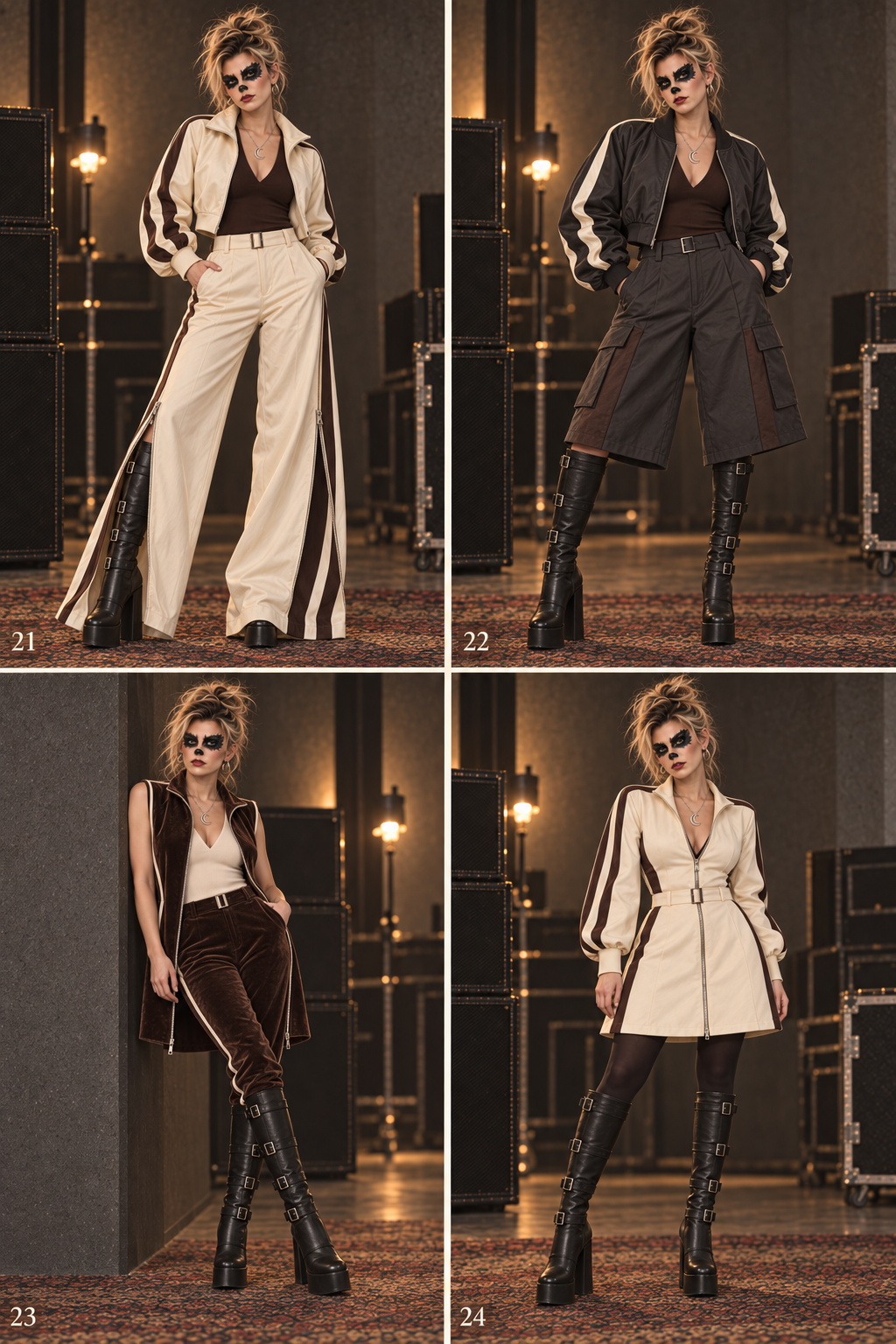
The visual direction did not arrive as a single perfect prompt. One pre-design sheet put four candidates next to each other: cream tailoring, dark shorts, a brown layered look, and a lighter zipped dress. Seen together, they forced a better question than “Which picture is prettiest?”: which silhouette could carry this character through portraits, a game sprite, album art, and moving scenes without losing recognition?
Sources: S9
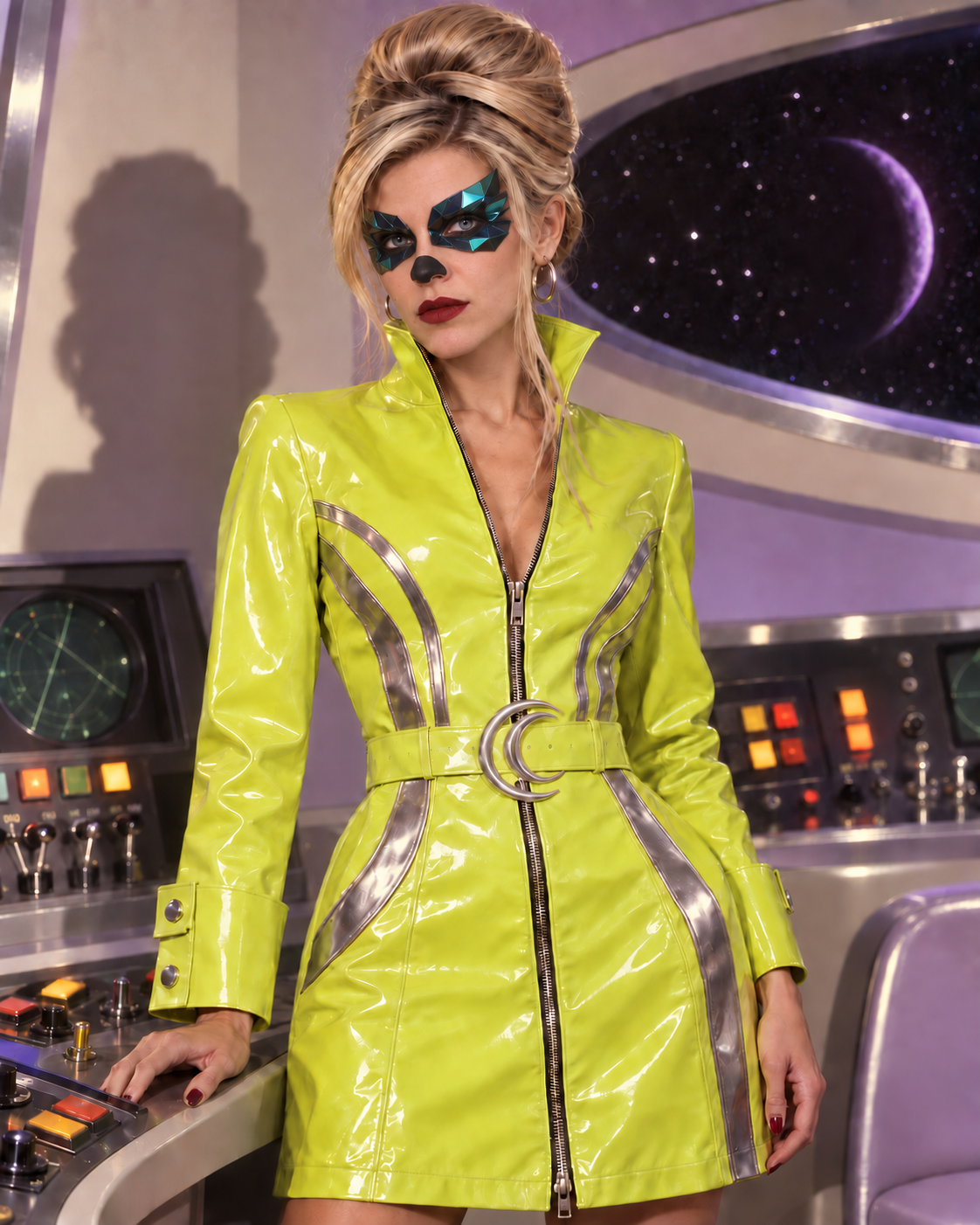
The selected Pop Stars references move toward a chartreuse coat dress with silver trim, swept-up blonde hair, faceted teal eye makeup, a black nose, and a retro ray gun. The final portrait makes the coat, hair, and eye treatment visible at human scale; the game and title art carry the ray gun into action. It is a change from the cyan helmet and lacquer-pink Pretty Machine world, while still treating Clarapetra as the same human-directed artist.
“Selected canonical” is a visual-reference status. It does not mean every marketing asset has cleared rights, review, and channel approval. That distinction belongs in the production record as clearly as it belongs in the art direction.
Sources: S12


Six worlds now carry the song
The public Pop Stars game turns that identity into a sequence: Bridge, Lunar Cliffs, Disco Orbit, Crystal Foundry, Neon Skyline, and Daddy B Mothership. Players move, jump, dash, aim, and fight through the campaign. Pop Stars carries the journey; “Ruby Red” (Daddy We Bounce) takes over for the final Daddy B encounter. A leaderboard gives the run a score to revisit.
Sources: S2
At the mothership, Daddy B moves across the fight, telegraphs an attack, and sends miniature enemies into the arena. The music switch now raises the pressure instead of simply changing a menu label. The optional opening cinematic is fiction inside the game world, not a literal biography of the artist. Desktop and phone checks, a real public ranked run, and repeated fixes preceded release.
Sources: S2
The larger business idea is to let one creative asset do more than one job. A song can set the pace of a level. A character portrait can guide sprite design. A boss can become a short clip, a still, or a reason to return. The useful measure is whether these forms make the work more understandable and enjoyable for the audience.
A campaign needs a control room
Alongside the public game, I am building a local Clarapetra Campaign Library. It is a workstation CMS for the less photogenic parts of an era: finding assets, assigning canonical visual slots, tracking rights and marketing status, comparing candidates, and exporting a campaign manifest. It runs locally and its production deploy control is locked by default; the library itself is not a public service.
Sources: S12
The current Pop Stars dashboard is unusually honest about the work ahead. It shows five of five canonical visual slots filled and a 40% readiness score, but zero approved marketing assets and zero channels assigned. It calls for a vertical visualizer or campaign video, three launch-ready approvals, a shortlist, and channel assignments. Those are workflow prompts, not claims that the launch kit is already complete.
Sources: S12
This is what makes the CMS part of the business rather than a folder with a nicer interface. It connects creative selection to provenance, rights, review, and distribution. A founder can see what can be shown now, what still needs a decision, and what should never be treated as cleared merely because it looks finished.
Sources: S12

Sources: S12
The stack has different jobs
ChatGPT Work helps turn a broad idea into research, decisions, drafts, and reviewable material. Codex helps carry decisions into local code, tests, browser checks, and a deployable product. Local development lets me inspect the game and CMS before release. Firebase Hosting serves the public game, while a scoped cloud backend verifies ranked scores.
The OpenAI API gives a business application features and automated media workflows beyond a chat window. At OMIKINA, scheduled Firebase jobs use it for article-audio production, and the public podcast feed carries those editions. For the earlier Pretty Machine campaign, I used Higgsfield to turn a reference-led portrait into the Magenta Rain Pavilion vertical motion piece; the production record tracks its finished file and social publication. A selected Pop Stars portrait could guide a future trailer test, but the documented game pixel art was made with OpenAI’s built-in image tool.
That separation is a professional discipline. A launch can move among a game, an image, a film experiment, an article, an audio edition, and a reusable campaign kit. Each format needs its own craft and its own proof that it is ready. The tools widen what a small team can attempt; the human job is to choose the work, direct it, check it, and name its real status.
A launch can become a multimedia system
Pop Stars suggests a repeatable pattern for more than music. A fashion brand could let people explore a collection before checkout, while a local library tracks samples and usage rights. A consumer product could turn its demonstration into a small interactive challenge, then reuse the same art direction in video and editorial. An independent artist can make a song playable, tell a fictional story around it, and keep the actual release status plain.
The temptation is to call every output a launch. The useful discipline is to ask what each one does for a real person. The game offers participation. A portrait makes the character recognizable. A CMS keeps the team from losing track of decisions. An article explains the work. Cloud automation can keep distribution and media generation moving, but it should report its state rather than invent completion.
The local Campaign Library makes the next decisions visible: clear three launch-ready marketing assets, assign distribution channels, and produce a vertical visualizer or campaign video. Then the game, imagery, article, and eventual record can point to one another with known rights and a real release plan. Players can enter the world now; the next business test is whether they choose to return.
Publisher’s note and project links
Clarapetra is a human-directed artist project created and directed by John N. Farmer, OMIKINA’s founder and accountable publisher. This is a house product announcement, prepared with AI assistance under his requested byline. The author portrait comes from John’s public portfolio. The visual examples are Clarapetra project assets and authentic game or local CMS captures; the outfit comparison was exploratory. Human editorial review of the finished text has not been recorded.
Play Pop Stars or visit the Clarapetra era homepage, then compare the earlier Daddy We Bounce preview. The local Campaign Library is shown here for production context; it is not open to public visitors. The source list below separates those first-party project records from the tool documentation.
Why it matters
Pop Stars shows how an independent creative business can make an era playable before its music release, carry one visual identity across formats, and use a local CMS to keep readiness and approvals honest. The public game is a delivered artifact; audience, retention, and commercial results still need to be measured.
Sources
- Clarapetra — Pop Stars era homepage — Clarapetra / OMIKINA Records
- Pop Stars — playable browser game — Clarapetra / OMIKINA Records
- Daddy We Bounce — playable preview — Clarapetra / OMIKINA Records
- Daddy We Bounce — John N. Farmer project case study — John N. Farmer
- Get started with ChatGPT Work — OpenAI
- Run long horizon tasks with Codex — OpenAI
- OpenAI API — text to speech guide — OpenAI
- Higgsfield Canvas — multi-node generation — Higgsfield
- Pop Stars pre-design outfit studies 21–24 — Clarapetra / OMIKINA ·
- Pop Stars selected canonical portrait — Clarapetra / OMIKINA ·
- Pop Stars live gameplay capture — Clarapetra / OMIKINA ·
- Clarapetra Campaign Library — local readiness capture — Clarapetra / OMIKINA ·
- Daddy We Bounce earlier preview capture — Clarapetra / OMIKINA ·
- OMIKINA — original articles podcast feed — OMIKINA
- Pretty Machine — Magenta Rain Pavilion video — Clarapetra / YouTube