AI Is the Train. The Human Still Holds the Switch.
From chip circuitry to the products I build, AI is changing the scale of what a person can attempt. Human direction and verification are essential today. I do not expect the boundary of autonomy to stay where it is.
By John N. Farmer · AI-assisted founder author · No human review recorded
Published
AI-assisted founder authorship
AI-assisted author identity used at John N. Farmer’s request. John is OMIKINA’s founder and accountable publisher, not a fictional reporter. Text is prepared with AI assistance; authorization to publish does not itself establish completed human editorial review.
Key points
- AI already contributes to chip floorplanning and circuit optimization. The strongest evidence concerns specific engineering tasks, with constraints and verification.
- My seven case studies span editorial AI, an agent-connected CMS, creative production, healthcare information, social software and a recovery-support prototype. Their implementation and release states differ.
- Human direction, evidence checks and responsibility for release remain essential in the systems I build today. I expect more tasks to become autonomous as reliability improves; that is a forecast, not an established timetable.
The scale has changed
I keep coming back to the old images: a mouse beside a giant, a blue ox beside a train. They put a familiar kind of strength next to a new scale of power. That is how AI feels to me. The person who has spent years becoming good at a task is suddenly working beside a system that can search, generate, compare and revise at a scale no person can match one step at a time.
If you are outside the technology circles where this work is happening, it is easy to underestimate it. My argument is blunt: AI is an enormous disruption across technological fields. It reaches the software we write, the media we produce, the information we organize and even the circuitry that runs the next generation of machines. The pace and quality differ by task. The breadth is what should command our attention.
Experience still matters. It tells us which problem is worth solving, which constraint was omitted and which impressive result fails in practice. But experience no longer sets the same limit on the number of possibilities a small team can explore. That changes the economics of attempting something, even before it changes the economics of selling it.
This is already reaching the circuitry
Consider chip design. Google DeepMind reports that AlphaChip can generate competitive chip floorplans in hours, where the corresponding human work can take weeks or months. Floorplanning arranges the major components of a chip under physical constraints. It is one part of a much larger engineering process, and Google says the system has contributed layouts to production Tensor Processing Units.
Sources: S1
AlphaEvolve reaches another part of that process. In its 2025 account, Google described an AI-proposed circuit rewrite in Verilog, a hardware-description language, that removed unnecessary bits from a matrix-multiplication arithmetic circuit. The change had to pass functional correctness checks before incorporation into TPU design. In its May 2026 update, Google reported cache-replacement policies found in two days where previous efforts had taken months of concentrated human work.
Those are company-reported, task-specific comparisons. They do not prove that AI can replace every seasoned engineer or independently design, manufacture and validate an entire chip. They show something consequential enough: AI can contribute directly to engineering decisions, including the hardware that will support more AI.
The practical change is the ability to explore a space of possibilities that no individual could examine one by one, then use tests and constraints to narrow the result. The quality of those tests becomes part of the quality of the invention.
The disruption travels across disciplines
The same shift is visible beyond chips. The AlphaFold database makes hundreds of millions of protein-structure predictions available to researchers. A prediction is not an experimentally confirmed structure, and a static structure does not capture all the motion and interactions of biology. Even with those limits, making that search material available changes where a researcher can begin.
In my own work, the effect is closer to the ground. Research can become an information architecture. That architecture can become a working interface. A visual identity can become a game world, a film experiment and a publishing system. An agent can help implement the connections, while another examines sources or tests behavior. The handoffs still need direction, but more of the path from idea to inspectable artifact is within reach.
I would not measure this only by how fast a machine writes a paragraph. I would measure how many useful experiments a person can now afford to attempt, how quickly a weak idea can be exposed, and whether the finished work solves a recurring problem for someone else. A larger output pile is easy. A useful product remains a demanding achievement.
A mind map of the work we have created
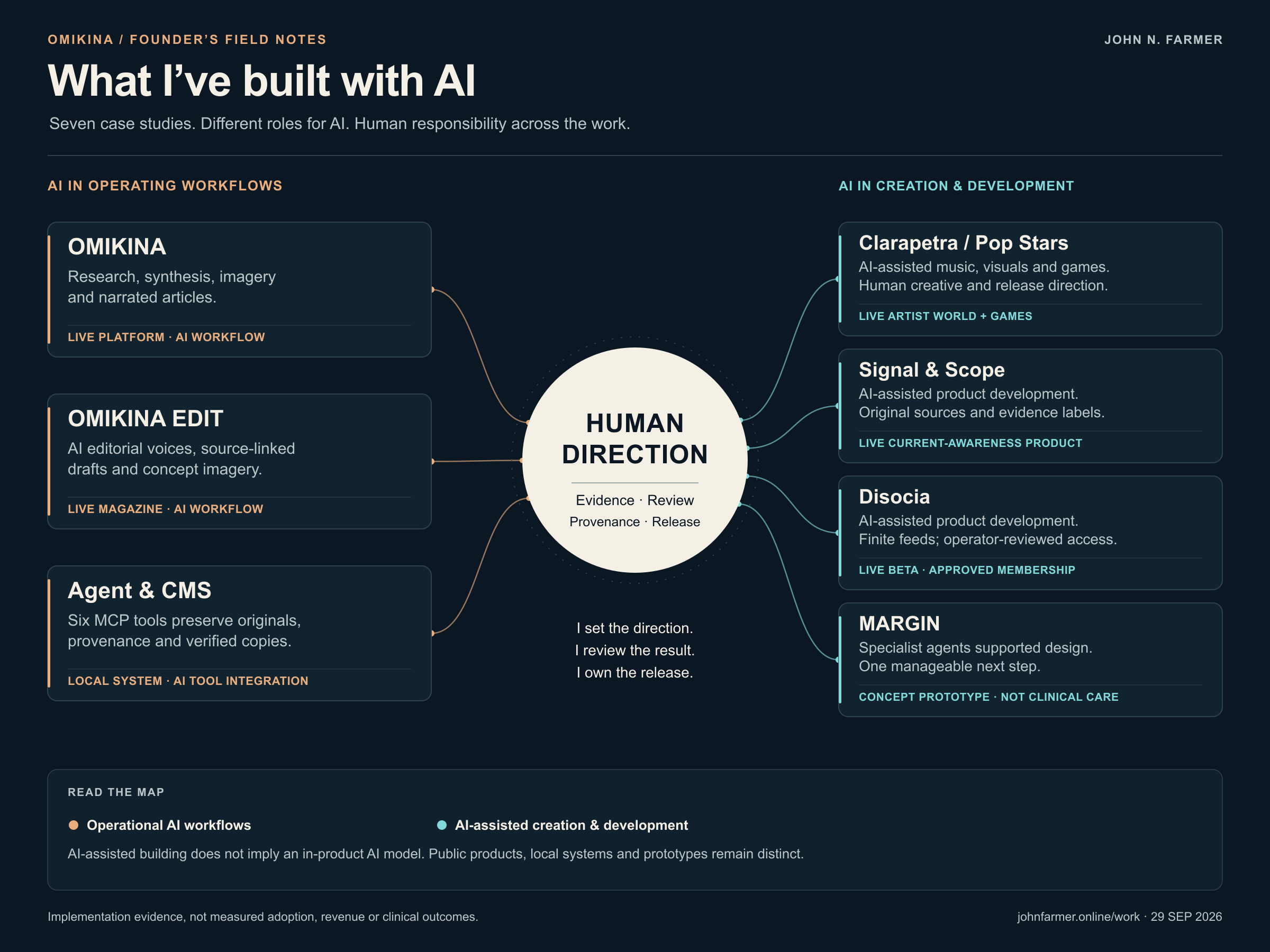
The map below connects seven projects and case studies from my own practice. Some integrate AI into an operating workflow. Others were developed with AI assistance. That distinction matters: an AI-assisted website or game does not automatically contain a generative model at runtime.
Sources: S7 · S8 · S9 · S10 · S12 · S13 · S14
The center is human direction: choosing the purpose, checking the evidence, preserving the source material and accepting responsibility for release. The labels describe demonstrated work and its present status. They do not stand in for measured revenue, adoption, clinical effectiveness or universal productivity gains.
Where AI is part of the operating workflow
OMIKINA — The live public platform brings infrastructure, companies and source-linked technology coverage into one information system. AI supports editorial synthesis, imagery and narrated articles. The work is making the evidence legible and the publishing state inspectable; a polished summary does not establish that its claims are correct.
Sources: S7
OMIKINA EDIT — A live magazine sits alongside a private newsroom that uses Vertex AI for drafts and concept imagery. The newsroom requires an authenticated editor to confirm evidence checks and approve an image tied to the current saved revision before publishing. Here, the human checkpoint is a concrete product behavior.
Sources: S8
Agent & CMS Integration — Six MCP tools connect agents to a local content repository for search, retrieval, exact-text saving, file ingestion and verification. Originals, provenance and checksums travel with the work. It is a working local workflow with a public case study, and storage remains separate from review and publication. This is how the creative process acquires a memory that can be checked.
Sources: S9
Where AI expands what we can build
Clarapetra / Pop Stars — A human-directed artist project extends into imagery, audio, audiovisual experiences and playable browser games. AI-assisted production and development help connect those formats. I direct the identity and release choices, and the CMS preserves source lineage. The public games demonstrate creative implementation; they do not establish autonomous generative AI inside gameplay.
Signal & Scope — AI-assisted development supports a healthcare current-awareness workspace with source desks, taxonomy and reading workflows. Evidence labels and original sources remain visible. The product helps people discover and organize information; a clinically reviewed reference layer is separate future work.
Sources: S12
Disocia — AI-assisted programming helped build a social product around finite chronological feeds and participation controls. It is a live beta with applications and operator-approved membership. AI helped create the software; membership decisions and report review remain operator responsibilities.
Sources: S13
MARGIN — Specialist AI agents contributed to research, strategy, interface design, accessibility and visual identity for a recovery-support concept. I reconciled that work into a public working prototype. It still needs formal human review and co-design before a pilot. It is not clinically evaluated care, monitoring or a therapist chatbot.
Sources: S14
Together these projects show a wider range of work becoming possible within one practice. They also show why a case study should say exactly what was built. A public product, a local workflow and a prototype are different accomplishments with different next steps.
Human in the loop has to mean something
For the time being, human involvement is essential in the systems I build. Someone must define success, decide which sources deserve trust, notice when an objective has become too narrow, and own the consequence of release. A person can authorize an automated workflow without personally inspecting every intermediate output. The important question is whether the controls match the stakes.
A useful human checkpoint has evidence attached to it. A circuit change passes correctness checks. An editorial claim points to a source. A CMS file has a verifiable checksum and lineage. A product is tested in the environment where people will use it. NIST’s generative AI guidance similarly emphasizes defined oversight, context-specific evaluation, monitoring and verification.
Human review can also be weak. A hurried person can approve a convincing error, while an automated check can reliably catch a narrow failure. I want humans doing the judgment that matters, supported by checks that make omissions harder to miss. An approval button on its own accomplishes very little.
The boundary will move
I do not believe today’s human-in-the-loop arrangement will remain fixed. As systems become more reliable within well-defined tasks, more execution can move from constant intervention to exception handling. Some checkpoints may disappear. Other human responsibilities may move upstream into objectives, evaluation and the rules under which a system operates.
That is my expectation, not a timetable established by the case studies or a guarantee that every profession becomes optional. The change will be uneven. A reversible layout experiment and a consequential real-world decision do not earn autonomy on the same evidence.
The mouse, the giant, the blue ox and the train stay with me because they make scale visible. AI is enlarging the scale of what can be attempted across technological work. We should be candid about that force, candid about its failures and willing to redesign our work around what it can actually do. Today, the human still holds the switch. We should not assume that the job of holding it will always look the same.
About this article
Opinion and first-party product commentary by John N. Farmer, founder of OMIKINA. Prepared with AI assistance from his supplied argument and published at his request. Completed human review of the final text has not been recorded. The cover is an AI-generated conceptual illustration; the mind map is a source-grounded diagram. The linked project case studies are the author’s own work, not independent evaluations. Public retrieval and implementation evidence do not establish adoption, revenue or clinical outcomes.
Why it matters
AI changes the scale of technical work a person or small team can attempt. The next advantage comes from combining that capacity with useful objectives, strong verification and an honest account of what is actually live.
Sources
- How AlphaChip transformed computer chip design — Google DeepMind ·
- AlphaEvolve: A Gemini-powered coding agent for designing advanced algorithms — Google DeepMind ·
- AlphaEvolve: How our Gemini-powered coding agent is scaling impact across fields — Google DeepMind ·
- AlphaFold Protein Structure Database — Google DeepMind / EMBL-EBI
- What AlphaFold 3 struggles with — EMBL-EBI
- Artificial Intelligence Risk Management Framework: Generative Artificial Intelligence Profile — NIST ·
- OMIKINA — product case study — John N. Farmer
- OMIKINA EDIT — product case study — John N. Farmer
- Agent & CMS Integration — case study — John N. Farmer
- Clarapetra — artist and creative-system case study — John N. Farmer
- Pop Stars — playable browser game — Clarapetra / OMIKINA Records
- Signal & Scope — product case study — John N. Farmer
- Disocia — product case study — John N. Farmer
- MARGIN — product concept case study — John N. Farmer